A Leader in Ultrafast Technology
 
introduction
products
expertise
customers
partnerships and collaborations
publications
career opportunities
FAQ
contact us

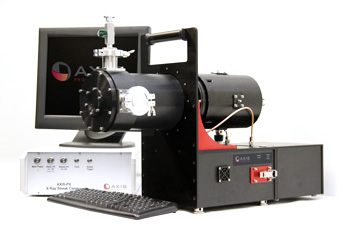
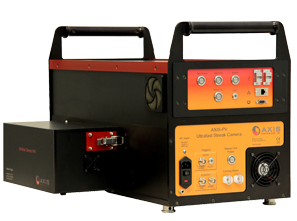
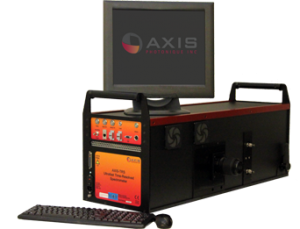
AXIS-PX: Ultrafast X-ray Streak Camera

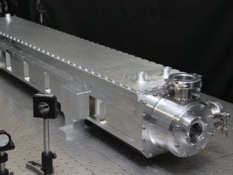
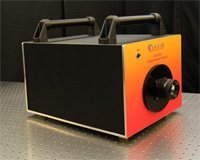
AXIS-PX is the first commercially available x-ray streak camera that can streak a 300 point image with a time resolution of 700 fs.

It was especially developped for time-resolved x-ray spectroscopy of ultrafast events.

Applications:

  • Characterization of laser-generated plasma sources
  • Z-pinch Plasma Diagnostics
  • Synchrotron Science
  • High Energy Physics
  • Inertial Confinement Fusion

Specifications Overview

Streak tube

Photonis x-ray bilamellar family:
These open tubes use bilamellar optics to provide a subpicosecond temporal resolution whilst maintaining excellent spatial resolution.

Click on image to enlarge

Spectral Response

Photocathode is interchangeable. The user chooses the cathode material to match his experiment.

Click on image to enlarge

Spatial Resolution

Photocathode length (X) 15 mm
Spatial Resolution (dx) 40µm with 50% contrast
Number of spatial resolution units in screen (X/dx) 375 points

Single-shot Sweep

Available Ranges (T) 200 ps to 1 ms
Number of time-resolution units in screen (Nt) 512
Single-shot Time Resolution For ranges > 500 ps: range/512

For ranges < 500 ps: 700 fs


Click on image to enlarge

Click on image to enlarge

Averaged Sweep

Trigger type For ranges > 5ns: Electrical (10-35V in 50Ω)
For ranges < 5ns: CPA laser pulse (with laser-triggered sweep unit)
Trigger rate single shot to 10 kHz
Trigger jitter For ranges > 5ns: <15 ps RMS
For ranges < 5ns: 500 fs RMS
Time Resolution For ranges > 1ns: range/512
For ranges < 1ns: 700 fs

Readout

Readout type Thermo-Electrically-Cooled Digital camera
CCD chip size 2048x2048 pixels; 27 mm x 27 mm
Digitizer 16 bits
Coupling to streak tube 1:1 Fiber optic taper
Cooling 15-20 °C cooling water is required for the CCD camera

Operation modes

Normal sweep The sweep starts out of the screen, crosses the whole screen and ends outside the screen.
Timing mode The sweep starts in the screen and ends also the screen. It is used to synchronize the streak camera to the event.
Focus mode A static voltage is applied to position the trace close to the center of the screen. The sweep trigger is disabled. This mode is used to adjust the incident light into the streak camera.

Vacuum

Operation Pressure  < 1x10⁻⁵ torr at the cathode
Vacuum flange ISO-200 for re-entrant camera,
ISO-160 for High-End camera
or custom flanges
Storage chamber Each x-ray streak camera comes with a small vacuum chamber equipped with a UV window for calibration or storage.

Offered configurations

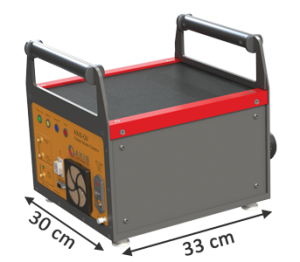
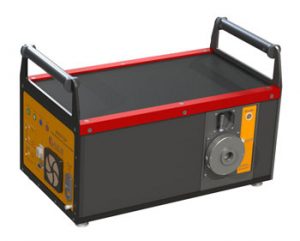
Basic Re-entrant vacuum head and remote electronics

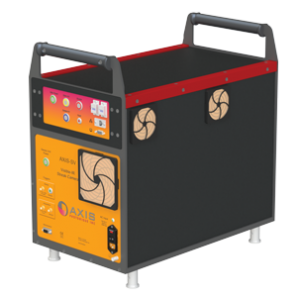
High-end remote-controlled system

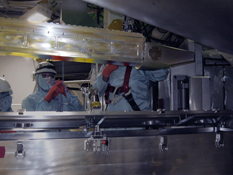
Fully integrated airbox for Ten-Inch Manipulator


General

Electrical input Universal AC, 110-240V, 50-60 Hz
Certification CE
Tests and Calibration Before shipping, each system is tested on a femtosecond laser at the Advanced Laser Light Source.
Installation and Training A qualified engineer is sent to your laboratory to install the system and train users

Options

Blanking circuits With the blanking option, streak tube is blocked during the time the signals sweeps back to its start position. This feature is required when the optical signal lasts longer than the sweep range.
Remote control over Optical Ethernet to operate system via optical Ethernet 1 Gbs (1000 Base SX).
Laser-triggered sweep unit for CPA lasers

Because of its 500 fs RMS jitter, this unit allows the analysis of ultrafast events at repetition rates up to 10 kHz while conserving the excellent spatial and temporal resolution of the AXIS streak camera. This is the ideal tools ultrafast spectroscopy with large dynamic range and high signal-to-noise ratio

It requires about 100 µJ per laser pulse.

Only a fraction of the laser energy is taken to trigger photoconductive switches. This allows signal averaging over a large number of laser shots.

XUV spectrum of Carbon averaged over 600 shots at 10 Hz with a temporal resolution of 4 ps.
M. Nantel, et al, Phys. Rev. Let. 80, 4442 (1998)

Timing fiducial input fiber This assembly allows sending a timing UV pulse on the photocathode. This pulses is sent through a UV optical fiber. This is to record an absolute time reference on each shot.
Slow scan mode Operation mode in which the sweep crosses the whole screen in 0.5 to 15 second. It is used to characterize spatial non-uniformity in the instrumental response by illuminating it with a constant brightness light source.
24V supply To power the whole system with a DC voltage between 23V and 28V.
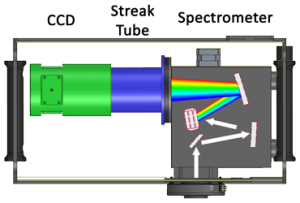
X-ray Spectrometer X-ray spectrometer that fits special needs.

Contact us for more information