Frequently Asked Questions
Glossary
Streak Camera
A streak camera is a device to measure the time dependence of very fast
and very weak optical signals. Its main component is a vacuum electron tube
which integrates:
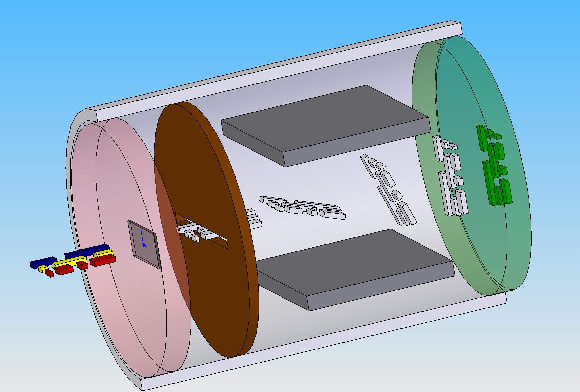
- A photocathode to transform the incident photons into electrons;
- Electron optics to accelerate those electrons to an energy of 15 keV
(which corresponds to a velocity of more than 260 million km/h or 25%
of the speed of light) and focus them on a screen;
- A phosphor screen to transform each electron into many visible photons
which can then be read on a photographic film or a CCD camera;
- A set of deflection plates to apply a linearly increasing voltage while
the electrons travel between them. The temporal information contained in
the electron pulse (therefore in the incident optical signal) is transformed
into spatial information on the screen.
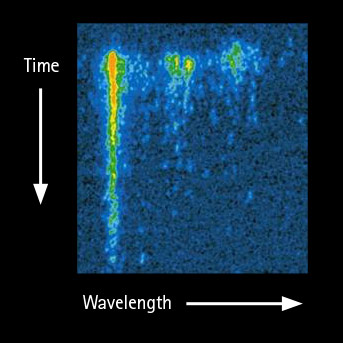
A 3-dimension image is obtained for a every optical pulse incident on the
photocathode. The intensity of the signal collected on the screen corresponds
to the intensity of the incident signal, the horizontal and vertical axis
correspond respectively to the time and the position along the cathode.
In some applications, one can replace the spatial dimension by a spectral
dimension by placing a spectrometer in front of the streak camera.
Lasers
- CPA Lasers
- Laser systems using the Chirped Pulse Amplification (CPA) technique
to amplify femtosecond pulses to Terawatt level.
The typical characteristics
of this type of lasers are given in the following table:
| <0.03 |
10 |
1000 |
| 0.5-10 J |
50-500 mJ |
0.1-1 mJ |
| 300 fs - 1 ps |
100-500 fs |
50-200 fs |
| 0.5- 50 TW |
0.1-5 TW |
0.5-20 GW |
Time Units
- Short pulse
- In this research field, "short" corresponds to time a
duration typically of the order of 1 picosecond
or shorter.
Picosecond
- 1 picosecond (ps) =10-12 second, or 1 millionth of 1 millionth of a second.
1 picosecond (ps) = 1000 femtosecond (fs)
In 1 picosecond, light travelling at 300 000 km/s, travels only 0.3 mm.
Subpicosecond
- A time duration shorter than 1 picosecond and typically longer than 100 femtosecond.
Femtosecond
- 1 femtosecond (fs) = 10-15 second, or 1 millionth of 1 billionth of a second.
Other Units
- Energy
- Energy is measured in Joules.
1 Joule (J) = 1000 millijoules (mJ)
Power
- Power is measured in Watts which corresponds to 1 Joule per second.
1 Terawatt (TW) = 1000 Gigawatt (GW) =1012 Watts
Intensity
- Intensity of light is measured in W/cm2. When
focussed on a target, a femtosecond laser pulse can produce an
intensity up to 1019 W/cm2. As a comparison,
the intensity of sunlight received on earth is about 0.1
W/cm2.